REIT vs. DST: Which Route Can Lead to Better Charitable Giving?

For many real estate investors, the thought of selling your portfolio is often dampened by a sobering reality: the 40% tax trap, a “miserable math” that blends federal capital gains tax, depreciation recapture, net investment income tax, and state taxes. After years of managing tenants, toilets, and trash, the transition to a passive lifestyle usually requires selling your portfolio and the unwelcome tax hit.
However, you can exit the “landlord” business without that tax hit by using a Delaware statutory trust. If you are someone whose real estate holdings were tied up in a real estate investment trust (REIT), you may find your path toward charitable giving far easier to travel.
While REITs are the household name in passive real estate, the DST offers a sophisticated tax-saving toolkit, particularly for those navigating 1031 exchanges or wanting to build a longer and larger charitable legacy.
This article will discuss the similarities and differences between the two paths and provide further insights on their tax impact and their ability to function as a tool to fund long-term charitable giving.

Definitions & Core Similarities
A REIT is a company that owns and operates income-producing real estate. A DST is a legal vehicle that allows direct, fractional ownership of income-producing real estate. Although they may seem very similar, think of the difference between buying a ticket to a cruise ship (REIT) versus joining a small group to buy a private yacht (DST).
Both trusts can provide the following:
Passive Nature & Income: Your days of doing the physical work of maintaining and managing real estate are over. You enjoy a regular cash flow as an investor.
Institutional Quality: These trusts own large warehouses, resort properties, and office towers that are nearly always out of reach of the majority of real estate investors.
The Key Differences
The chart below provides contrast between each:
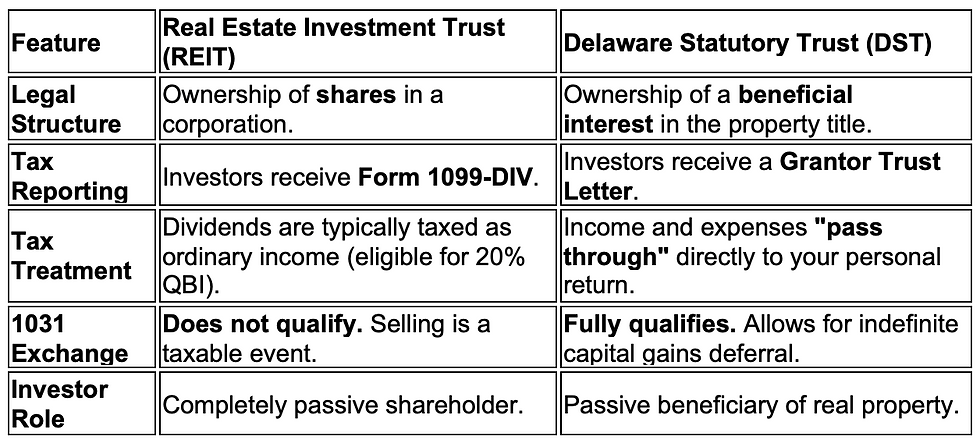
Tax Savings Face-Off
The two choices differ in the following:
Depreciation: DSTs allow you to claim your share of the real estate depreciation to offset income; REITs manage depreciation at the corporate level before you see the dividend.
Step-Up Basis: Both offer a "step-up" at death of the owner, but the DST’s direct ownership can sometimes offer a cleaner reset for heirs who wish to continue to utilize a 1031 exchange.
State Taxes: DSTs can shield non-resident beneficiaries from income tax in certain states.
Which is Better for Building a Charitable Legacy?
When it comes to charitable giving, the "best" path depends entirely on whether you prioritize simplicity or a sophisticated, multi-generational legacy. Here is a breakdown of how these two strategies function.
REIT: Streamlined Giving
For many investors, the most efficient way to give is by donating highly appreciated REIT shares directly to a donor advised fund (DAF). Because REITs are typically liquid and traded like stocks, you can transfer the shares to your DAF without the headache of a complex appraisal or a long waiting period.
The magic of this strategy lies in the double tax benefit: you bypass the capital gains tax that would have been triggered if you sold the shares yourself, and you receive an immediate tax deduction for the full fair market value of the shares. It’s an ideal move for the investor who wants to rebalance a portfolio, offload a winner, and fund their charitable giving for years to come with one simple transaction.
DST: Heritage Building
A DST can be paired with a charitable remainder trust (CRT). In this scenario, you aren't just giving money away; you are creating a private pension for yourself while securing a future gift for charity.
By placing a DST interest—or the proceeds from a 1031 exchange into a DST—within a CRT, you effectively remove that asset from your taxable estate. You (or your heirs) receive a steady income stream for life, powered by the institutional-grade real estate held within the DST.
Once the term of the CRT ends, the remaining assets go to your chosen charity. This strategy is less about "writing a check" and more about sophisticated wealth preservation, allowing you to diversify out of a single property while keeping the income wheels turning indefinitely.
Next Steps
Ultimately, the choice between a REIT and a DST isn’t just a financial calculation; it reflects your long-term vision.
If your priority is maximum flexibility and a "clean break" from the complexities of property titles, the liquid nature of a REIT combined with a donor advised fund offers an elegant and easy path to making charitable gifts.
However, if you are looking to avoid the "40% tax trap" while maintaining the institutional power of real estate, the DST-to-CRT pipeline allows you to transform a lifetime of real estate investment into a self-sustaining engine for both your family and your favorite causes.
At Generosity Nexus, our expertise can help you choose the right vehicle for your goals. We can ensure that your transition to a passive lifestyle can cement a charitable legacy that will allow you to do good for years to come.
Don’t hesitate to schedule an appointment to learn more about how we can help you.